Download The Halo Effect: . . . and the Eight Other Business Delusions That Deceive Managers, by Phil Rosenzweig
When someone should visit the book stores, search shop by establishment, shelf by shelf, it is really bothersome. This is why we give guide compilations in this website. It will reduce you to look guide The Halo Effect: . . . And The Eight Other Business Delusions That Deceive Managers, By Phil Rosenzweig as you such as. By looking the title, publisher, or authors of the book you really want, you could find them rapidly. Around the house, office, or perhaps in your method can be all finest area within net connections. If you want to download and install the The Halo Effect: . . . And The Eight Other Business Delusions That Deceive Managers, By Phil Rosenzweig, it is extremely easy then, because now we proffer the connect to purchase and also make deals to download and install The Halo Effect: . . . And The Eight Other Business Delusions That Deceive Managers, By Phil Rosenzweig So easy!
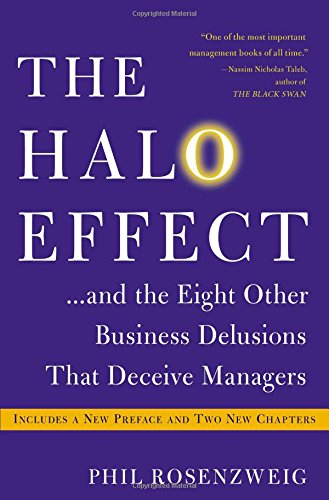
The Halo Effect: . . . and the Eight Other Business Delusions That Deceive Managers, by Phil Rosenzweig

Download The Halo Effect: . . . and the Eight Other Business Delusions That Deceive Managers, by Phil Rosenzweig
Only for you today! Discover your favourite e-book right here by downloading and also getting the soft file of guide The Halo Effect: . . . And The Eight Other Business Delusions That Deceive Managers, By Phil Rosenzweig This is not your time to typically likely to guide stores to purchase an e-book. Right here, varieties of book The Halo Effect: . . . And The Eight Other Business Delusions That Deceive Managers, By Phil Rosenzweig as well as collections are available to download and install. Among them is this The Halo Effect: . . . And The Eight Other Business Delusions That Deceive Managers, By Phil Rosenzweig as your preferred publication. Obtaining this e-book The Halo Effect: . . . And The Eight Other Business Delusions That Deceive Managers, By Phil Rosenzweig by on the internet in this website can be understood now by checking out the web link page to download and install. It will certainly be very easy. Why should be below?
As understood, many individuals say that e-books are the vinyl windows for the globe. It does not suggest that purchasing book The Halo Effect: . . . And The Eight Other Business Delusions That Deceive Managers, By Phil Rosenzweig will certainly mean that you can get this globe. Simply for joke! Checking out a book The Halo Effect: . . . And The Eight Other Business Delusions That Deceive Managers, By Phil Rosenzweig will opened up an individual to assume far better, to keep smile, to delight themselves, as well as to motivate the understanding. Every book likewise has their characteristic to affect the visitor. Have you recognized why you review this The Halo Effect: . . . And The Eight Other Business Delusions That Deceive Managers, By Phil Rosenzweig for?
Well, still puzzled of ways to obtain this e-book The Halo Effect: . . . And The Eight Other Business Delusions That Deceive Managers, By Phil Rosenzweig below without going outside? Simply connect your computer system or device to the net as well as start downloading and install The Halo Effect: . . . And The Eight Other Business Delusions That Deceive Managers, By Phil Rosenzweig Where? This web page will certainly show you the link page to download and install The Halo Effect: . . . And The Eight Other Business Delusions That Deceive Managers, By Phil Rosenzweig You never ever worry, your preferred e-book will certainly be quicker your own now. It will be a lot easier to enjoy reviewing The Halo Effect: . . . And The Eight Other Business Delusions That Deceive Managers, By Phil Rosenzweig by on the internet or obtaining the soft data on your gadget. It will certainly despite who you are and just what you are. This e-book The Halo Effect: . . . And The Eight Other Business Delusions That Deceive Managers, By Phil Rosenzweig is composed for public and you are among them who could delight in reading of this book The Halo Effect: . . . And The Eight Other Business Delusions That Deceive Managers, By Phil Rosenzweig
Spending the extra time by reviewing The Halo Effect: . . . And The Eight Other Business Delusions That Deceive Managers, By Phil Rosenzweig could provide such great encounter even you are only sitting on your chair in the workplace or in your bed. It will not curse your time. This The Halo Effect: . . . And The Eight Other Business Delusions That Deceive Managers, By Phil Rosenzweig will lead you to have more precious time while taking remainder. It is extremely satisfying when at the noon, with a cup of coffee or tea and a publication The Halo Effect: . . . And The Eight Other Business Delusions That Deceive Managers, By Phil Rosenzweig in your gadget or computer system display. By delighting in the views around, here you can start reviewing.
With two new chapters and a new preface, the award-winning book The Halo Effect continues to unmask the delusions found in the corporate world and provides a sharp understanding of what drives business success and failure.
Too many of today’s most prominent management gurus make steel-clad guarantees based on claims of irrefutable research, promising to reveal the secrets of why one company fails and another succeeds, and how you can become the latter. Combining equal measures of solemn-faced hype and a wide range of popular business delusions, statistical and otherwise, these self-styled experts cloud our ability to think critically about the nature of success.
Central among these delusions is the Halo Effect—the tendency to focus on the high financial performance of a successful company and then spread its golden glow to all its attributes—clear strategy, strong values, brilliant leadership, and outstanding execution. But should the same company’s sales head south, the very same attributes are universally derided—suddenly the strategy was wrong, the culture was complacent, and the leader became arrogant.
The Halo Effect not only identifies these delusions that keep us from understanding business performance, but also suggests a more accurate way to think about leading a company. This approach—focusing on strategic choice and execution, while recognizing the inherent riskiness of both—clarifies the priorities that managers face.
Brilliant and unconventional, irreverent and witty, The Halo Effect is essential reading for anyone wanting to separate fact from fiction in the world of business.
- Sales Rank: #158740 in Books
- Brand: Rosenzweig Phil
- Published on: 2014-06-17
- Released on: 2014-06-17
- Original language: English
- Number of items: 1
- Dimensions: 8.37" h x .70" w x 5.50" l, .57 pounds
- Binding: Paperback
- 288 pages
- The Halo Effect and the Eight Other Business Delusions That Deceive Managers
From Publishers Weekly
This tart takedown of fashionable management theories is a refreshing antidote to the glut of simplistic books about achieving high performance. Rosenzweig, a veteran business manager turned professor, argues that most popular business ideas are no more than soothing platitudes that promise easy success to harried managers. Consultants, journalists and other pundits tap scientifically suspect methods to produce what he calls "business delusions": deeply flawed and widely held assumptions tainted by the "halo effect," or the need to attribute sweeping positive qualities to any company that has achieved success. Following these delusions might provide managers with a comforting story that helps them frame their actions, but it also leads them to gross simplification and to ignore the constant demands of changing technologies, markets, customers and situations. Mega-selling books like Good to Great, Rosenzweig argues, are nothing more than comforting, highbrow business fables. Unfortunately, Rosenzweig hedges his own principles for success so much that managers will find little practical use for them. His argument about the complexity of sustained achievement, and his observation that success comes down to "shrewd strategy, superb execution and good luck," may end up limiting the market for this smart and spicy critique. (Feb. 6)
Copyright © Reed Business Information, a division of Reed Elsevier Inc. All rights reserved.
Review
"In "The Halo Effect," Phil Rosenzweig has done us all a great service by speaking the unspeakable. His iconoclastic analysis is a very welcome antidote to the kind of superficial, formulaic, and dumbed-down matter that seems to be the current stock in trade of many popular business books. It's the right book at the right time."-- John R. Kimberly, Henry Bower Professor of Entrepreneurial Studies, The Wharton School, University of Pennsylvania
"I was taken by this book. It destroys myths concerning the attribution of success in the management literature using potent empirical arguments. It should stand as one of the most important management books of all time, and an antidote to those bestselling books by gurus presenting false patter and naive arguments." -- Nassim Nicholas Taleb, author of "Fooled by Randomness: The Hidden Role of Chance in Life and in the Markets"
"Rosenzweig doesn't only poke fun at the mass of bad writing and bad science in the management world. He explains why it is so bad -- and how you can learn from it, despite the efforts of the authors." -- John Kay, "Financial Times" columnist and author of "Everlasting Light Bulbs: How Economics Illuminates the World"
"In "The Halo Effect", Phil Rosenzweig has done us all a great service by speaking the unspeakable. His iconoclastic analysis is a very welcome antidote to the kind of superficial, formulaic, and dumbed-down matter that seems to be the current stock in trade of many popular business books. It's the right book at the right time." -- John R. Kimberly, Henry Bower Professor of Entrepreneurial Studies, The Wharton School, University of Pennsylvania
"Business books all too rarely combine real-world savvy with scientific rigor. Rosenzweig's book is an outstanding exception -- it's a superb work and long overdue." -- Philip E. Tetlock, Lorraine Tyson Mitchell II Chair in Leadership and Communication, Haas School of Business, University of California, Berkeley
About the Author
Phil Rosenzweig is a professor at IMD in Lausanne, Switzerland, where he works with leading companies on questions of strategy and organization. He earned his PhD from The Wharton School, University of Pennsylvania, and spent six years on the faculty of Harvard Business School. He is a native of Northern California. Comments to the author can be sent to Phil@The-Halo-Effect.com.
Visit The-Halo-Effect.com to download a user’s guide to The Halo Effect for your company or classroom, or to join a discussion forum about delusions in the business world.
Most helpful customer reviews
3 of 3 people found the following review helpful.
Wonderful Addition to Any Manager’s Bookshelf
By Brad A. Clark
The Halo Effect: ... and the Eight Other Business Delusions That Deceive Managers by Phil Rosenzweig and published in 2007 by Free Press is a business management book critical of much popular thinking in the business world related to what makes a company successful. The title is taken from the term coined by the psychologist Edward Thorndike regarding cognitive biases where a person’s overall opinions are formed by a narrow range of data.
Rosenzweig outlines nine delusions often perpetuated in the business world via popular books and journalism. He argues that business success is far more complex than popular books lead readers to believe and that nothing works all the time for all businesses. Rosenzweig begins in chapter 1 asking the question, “Why do some companies prosper while others fail?” A couple of chapters later, he defines the first delusion, The Halo Effect, which sets the tone for the remainder of the book and sums up many of the delusions.
Rosenzweig does a wonderful job of explaining each of the delusions in common language and giving examples from real businesses to support his position. These chapters are spent demonstrating that many of the observations made about a firm are not drivers of performance but mere attributions based on that performance. The failure of many supposed business success models is the lack of data collection with scientific rigor and causality determined by association. Much of the data purported to lead to success are obtained based on retrospective studies and the “armchair quarterback” approach.
Starting in Chapter 9, Rosenzweig asks the question, “What leads to high performance?” He summarizes the answer into strategy and execution. Rosenzweig discusses the risky nature of strategy and the inherent unknowns as to the outcome of strategy decisions. The risk enters from influences such as uncertain customer demands, unpredictable competitors, and changing technology. The ultimate goal of strategic leadership is to gather information, to evaluate it thoroughly, and to make informed decisions that provide the best chances for success in a competitive setting.
Execution takes place within the company and is influenced by less risky factors. Execution does still involve many unknowns because of the collection of workers, equipment, technology, ideas, and attitudes within a company. Mangers tend to discuss execution in generic terms and would do well to focus on a few specific, measureable goals to complement the chosen strategy. When companies are under-performing, execution is typically blamed. However, a wise manager will examine whether the company even has the right strategy.
A few drawbacks of the book include the following. The book tends to use cases from decades ago that may be too distant for the reader. However, the most recent edition of the book contains two new chapters with more current corporate issues and the recent recession. Another drawback is that some of the chapters leave the reader hanging as to the outcome for the company or possible solutions. Finally, as much as the book attempts not to be a new recipe for success, some of the discussion comes across as just another book on how to be successful in business.
Overall, this book is a wonderful addition to any manager’s bookshelf and provides many helpful insights and suggestions. The book is a quick read and well written. A particular strength of the book is its ability to stimulate the reader to think critically about business data and business writing. Critical thinking skills will serve any business manager well throughout his career.
2 of 2 people found the following review helpful.
the author discusses eight “delusions” that are often at the root of poor analysis. It is a fact that the business ...
By Chris Honan
We are a group of three MBA students who read this book and are giving this review as a part of a class assignment. We chose the Halo Effect because the class we are taking is on Strategic Business Analysis and the Halo Effect seemed likely to present some interesting ways to interpret traditional business analyses.
This book is essentially the observations of the author on how analysts, including those writing for business magazines and many business management books, fail to see through the biases (halos) created by a business’ financial success or failure. If a business is experiencing financial success, its “halo” will glow brightly and most of its characteristics will often be described in a favorable light. If a business is performing poorly financially, its halo will dim and all of its actions will likely be painted as missteps or errors. Additionally, the author discusses eight “delusions” that are often at the root of poor analysis.
It is a fact that the business world is complicated. According to the author it is because of the changing environment day after day, uncertainty in the economic variables, limited information for the decision making process, different circumstances underlying tremendous success, biases and halos that we are entangled. Many business management books promise methods that promise any business success if they follow the precepts inside. However, in reality, it is not possible for all businesses to be successful at the same time, and this book, the Halo Effect, clearly shows us fallacy of their claims. This book gives precise and unique examples of several business stories in which different scenarios are being analyzed.
This book is an easy to read page-turner for anyone interested in or working in the business world. In separate sections, Rosenzweig gives different examples in order to show the fact that business success is not only based on one or two certain variables such as simply focusing on strategy or execution or understanding the customers. Using a conversational writing style, his book drives us to think critically and to make in depth analyses regarding successful businesses. Lastly, the book shows that is there is a common tendency for Halos surrounding big, successful, and eminent corporations to be highly likely to affect our decisions, opinions and perspectives towards them. Here, this insightful and thought-provoking book teaches us to approach the business-oriented issues, success stories, and reputation bubbles more critically and deftly not to be fooled by those Halos stemming from those variables itself.
Despite all the positive aspects, we found some negative points. First of all, the book is a bit repetitive. Same examples for the same companies are used in different parts of the book. Another point is that there are no clear suggestions or solutions to action presented in the book. It may be disappointing for readers looking for these in a book. But the writer reports that there is no formula for success in business world.
All in all, The Halo Effect and the Eight Other Business Delusions that Deceive Managers is a must-have book for anyone interested in business. The examples and the explanations inside provides awareness of the halos in the business world. We strongly recommend reading this book.
0 of 0 people found the following review helpful.
Good to Great… it seems like every few years a ...
By Paul
“What leads to high performance in business?”
This seemingly simple question is the basis of all business theory. It has sprouted an entire industry of managerial books, each promising an answer and implying that by following some basic rules, any manager can make their business succeed. We know the names: In Search of Excellence, Built to Last, What Really Works, Good to Great… it seems like every few years a new blockbuster book takes the management field by storm. And yet despite the praise, despite all of the research, why do companies still fail?
The Halo Effect does not answer this question. Instead, it tackles the issue of why the “Holy Grail” of business questions is a white whale. Author Phil Rosenzweig believes that much of the research on business theory is corrupted by nine delusions. He makes a powerful argument that we prefer to tell stories explaining business rather than following accurate evidence.
The book starts with and frequently revisits the first delusion: the Halo Effect. Coined by American psychologist Edward Thorndike in his research about soldiers in World War I, this delusion involves the overall impression of a company biasing the perceptions of specific factors in it. When business is good, we are more likely to perceive things like managerial style, company culture, and strategy as drivers that led to success. When business is bad, those exact same factors are usually viewed negatively… regardless of whether they led to the poor outcomes or not!
The other delusions are:
The Delusion of Correlation and Causality, where cause and correlation are frequently confused.
The Delusion of Single Explanations, where parts of a business may be interconnected, but we delude ourselves into overestimating the effect of each one individually.
The Delusion of Connecting the Winning Dots, where researchers only examine successful companies.
The Delusion of Rigorous Research, stating that simply performing more research doesn’t lead to accurate conclusions if the research is flawed.
The Delusion of Lasting Success, which notes that almost all companies have high and low points rather than consistently succeeding.
The Delusion of Absolute Performance, where we overestimate the impact of a company’s business choices. A company may make all the “right choices” but still fail due to external factors.
The Delusion of the Wrong End of the Stick, where there’s a tendency to confuse cause and effect. The example in this book analyzes “the Hedgehog Concept” from Good to Great, stating that while successful companies tend to be focused (more conservative “hedgehogs” rather than more risk-taking “foxes”), that does not mean that all highly-focused companies succeed.
The Delusion of Organizational Physics, which states that no matter how well we set up our research and experiments, we will never achieve perfect conditions and results like we would in a laboratory.
The Halo Effect is not without its flaws. The author spends a large amount of time on the titular delusion, while some of the others barely get a mention. He also tears apart other books for faulty research and conclusions, but yet presents two factors he claims will lead to success and profiles business leaders he thinks are great managerial examples.
Thankfully the latest edition contains additional chapters, where Rosenzweig revisits his conclusions and admits they were not absolute. One of the leaders he gushed about previously was partly responsible for the Great Recession.
The Halo Effect won’t give you the key to consistent high performance. But it will provide insight into why we keep failing to answer the question, as well as making you aware of the delusions that you may be suffering from right now.
The Halo Effect: . . . and the Eight Other Business Delusions That Deceive Managers, by Phil Rosenzweig PDF
The Halo Effect: . . . and the Eight Other Business Delusions That Deceive Managers, by Phil Rosenzweig EPub
The Halo Effect: . . . and the Eight Other Business Delusions That Deceive Managers, by Phil Rosenzweig Doc
The Halo Effect: . . . and the Eight Other Business Delusions That Deceive Managers, by Phil Rosenzweig iBooks
The Halo Effect: . . . and the Eight Other Business Delusions That Deceive Managers, by Phil Rosenzweig rtf
The Halo Effect: . . . and the Eight Other Business Delusions That Deceive Managers, by Phil Rosenzweig Mobipocket
The Halo Effect: . . . and the Eight Other Business Delusions That Deceive Managers, by Phil Rosenzweig Kindle

Tidak ada komentar:
Posting Komentar